

Asteroid Bennu material shows organic precursor molecules that may have produced ingredients of life first formed from cryogenic ammonia.
Some 4.5 billion years ago, just as the first planetesimals formed in our solar system, a hodgepodge world of rock and various ices orbited the nascent Sun. This tiny world was so cold that even the carbon dioxide (CO2) and ammonia (NH3) hidden deep within were frozen solid. Though the Sun was too far away to provide much warmth, radioactive elements within the world’s core began to generate enough heat to melt the CO2 and NH3, which sublimed into gasses that coursed through pores and crevices and gradually polymerized into a thin organic film that adhered to rock surfaces.
One of the main challenges in understanding the early solar system is finding any pristine material from the period to examine—conditions that emerged as the solar system evolved altered much of what came before. Material collected from asteroid Bennu has allowed scientists at the UC Berkeley Space Sciences Lab (SSL), Lawrence Berkeley National Lab (Berkeley Lab) and NASA to examine this early period for the first time. In a paper published today in Nature Astronomy, they identified nitrogen-rich compounds that were not previously known to occur in nature, and they’ve shown how the emergence of the molecular ingredients thought necessary for life may have begun in cryogenic environments during the infancy of our solar system.
The material that yielded these findings was collected by NASA’s Origins, Spectral Interpretation, Resource Identification, and Security–Regolith Explorer (OSIRIS-REx), which passed by Earth and released a sample return capsule containing 121.6 grams of rock and dust from asteroid Bennu in September of 2023. In a previous study published early this year in the journal Nature, Gainsforth and colleagues at Berkeley Lab described how an examination of that material with the Advanced Light Source synchrotron revealed evidence that a saltwater environment once existed within Bennu.
“This is the first evidence of organics forming on an asteroid in that brief period after the asteroids were first assembled but before they got hot enough for water to melt,” said Zack Gainsforth, a research scientist at SSL and co-author of the study.
Publication of the saltwater research coincided with a study published by the OSIRIS-REx team in the journal Nature Astronomy in which mass spectrometry revealed that Bennu samples contained 14 of 20 amino acids found in Earth biology as well as all five nucleobases found in DNA and RNA. Though amino acids and nucleobases are thought of as the basic ingredients of life, they assemble into complex molecules that are anything but simple and were unlikely to have spontaneously assembled themselves all at once. Gainsforth, along with co-authors Scott A. Sandford and Michel Nuevo of NASA’s Ames Research Center, wanted to understand how exactly these prebiotic molecules emerged.
Previous analysis confirmed that asteroid Bennu is a so-called rubble pile asteroid—an agglomeration of debris from the destruction of several different parent bodies. The oldest material from asteroid Bennu appeared to be from a parent body that also had irregular composition. This proved an essential factor in the preservation of chemical markers that Gainsforth and Sandford hoped to find. Using infrared microscopy, they found particles associated with organic nitrogen. Using X-ray and electron microscopy, they discovered that these rare particles contained sheet-like material only a few micrometers thick but with several distinct layers sandwiched together. The combined analysis confirmed that each layer had a specific chemical composition and relationship to the surrounding asteroid material that suggested a particular series of events within the parent body of Bennu. Strikingly, the organic has a very high concentration of amines and amides—compounds important to life.
“It was amazing,” said Sandford. “By studying microscopic grains of material, we were able to understand things that happened billions of years ago on a remote asteroid.”
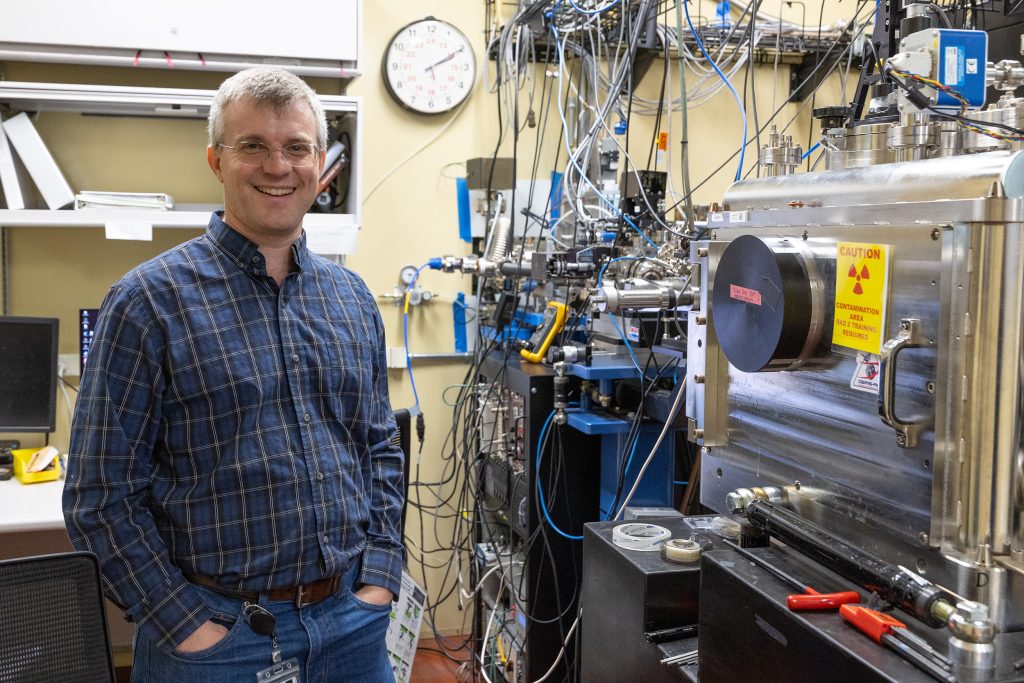
Zack Gainsforth at the Lawrence Berkeley National Laboratory’s Advanced Light Source (Credit: UC Berkeley SSL, Alan Toth) 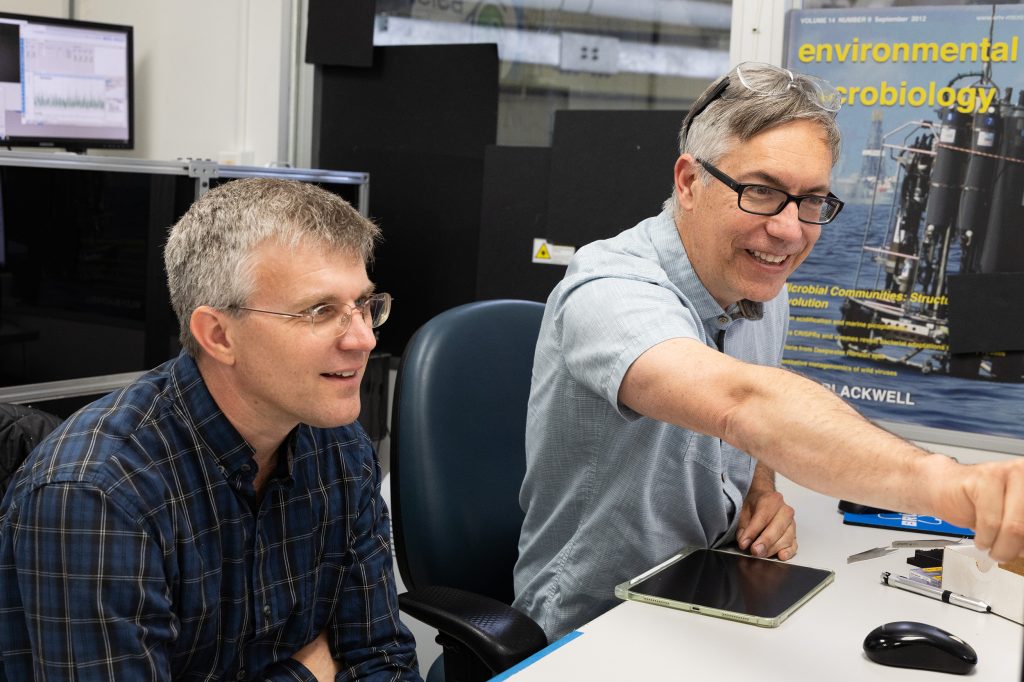
Zack Gainsforth(left) and Hans A. Bechtel(right) at the Lawrence Berkeley National Laboratory’s Advanced Light Source (Credit: UC Berkeley SSL, Alan Toth) 
Zack Gainsforth(left) and Hans A. Bechtel(right) at the Lawrence Berkeley National Laboratory’s Advanced Light Source (Credit: UC Berkeley SSL, Alan Toth) 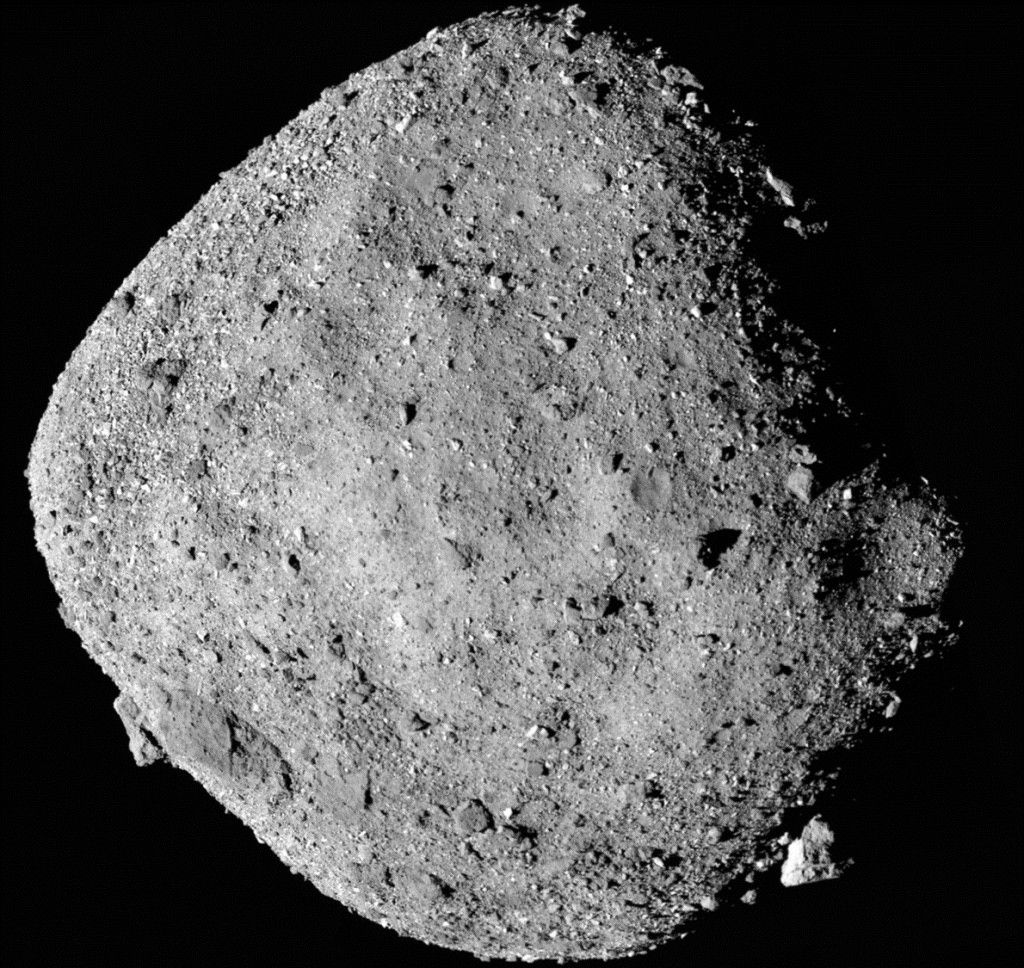
This mosaic image of asteroid Bennu is composed of 12 PolyCam images collected on Dec. 2 by the OSIRIS-REx spacecraft (Credit: NASA/Goddard/University of Arizona) 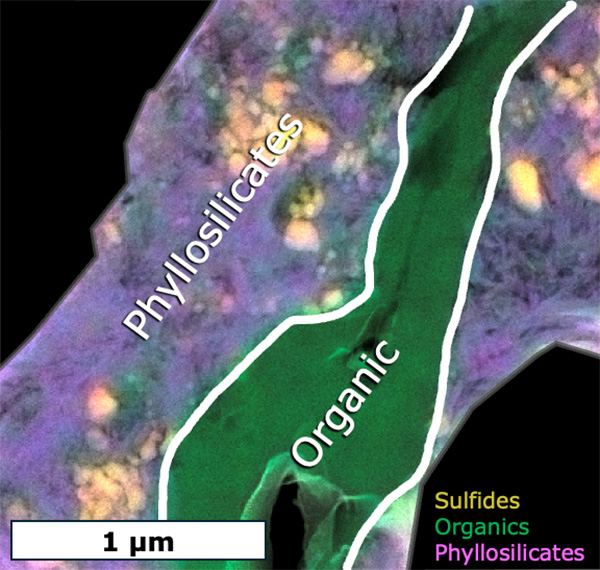
The N-rich organic phase (green) is shown sandwiched between two regions of phyllosilicate (purple) and sulfide (yellow). (Edit: Sandford/Gainsforth)
As the parent body warmed, CO2 and NH3 reacted to form a compound called ammonium carbamate. This compound adhered to the surfaces of ice and mineral grains and polymerized, eventually forming an organic layer. At some point, impacts or other events generated enough heat to melt water ice, which melted and absorbed remaining ammonia and any unpolymerized carbamate. If not for the polymer layer, all evidence of primordial NH3 reactions might have been lost. Fortunately, the polymerized carbamate was water-insoluble and thus resistant to destruction. As water eroded rock, it left behind other markers on the polymer—carbonate crystals for instance—as evidence of further transformation.
Thanks to these thin films, Gainsforth, Sandford, and Nuevo were able to see how CO2 and NH3 could combine within a frozen environment and eventually become amines and amide polymers (some of the chemical components of amino acids). If not for the unusual composition of the layered films, and their unique physical structure, it would have been very difficult to understand the multitude of steps involved in their formation and evolution. For Gainsforth, the extremely complex chemical process that produced the material is matched only by the incredible effort necessary to acquire it.
“We had to travel billions of miles to get this stuff, and we went to extraordinary lengths to preserve and analyze it,” said Gainsforth. “If humanity is able to do this, then there’s nothing we can’t accomplish.”