
By Alan Toth

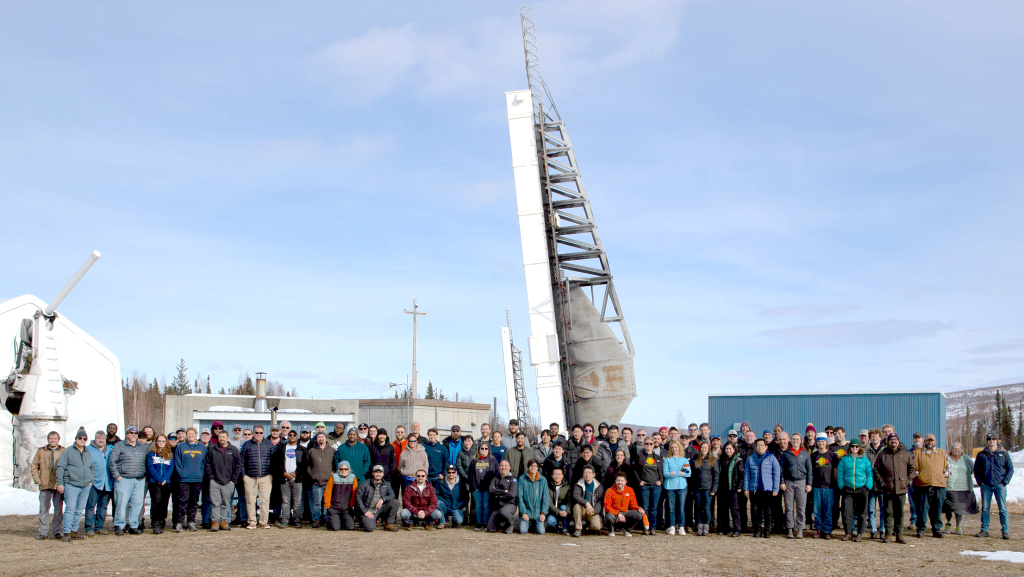
Credit: FOXSI team
June 11, 2026
On May 14 — with only two days left in their two-week launch window — the fifth iteration of the NASA-funded Focusing Optics X-ray Solar Imager (FOXSI-5) sounding rocket blasted off a launchpad at the University of Alaska Fairbanks’ Poker Flats Research Range. Unlike the massive rockets that carry crewed missions to space, the relatively small FOXSI-5 didn’t gradually rise from a billowing inferno but rather zipped into the atmosphere on a column of smoke.
Within two minutes, FOXSI-5 was capturing images of the Sun with seven telescopes designed to image the high-energy X-rays produced by solar flares. By the time the rocket reached its zenith at some 300 km and began falling back toward the Earth, it had imaged three small-sized flares. As FOXSI-5 reentered the atmosphere, its parachutes deployed and it gently landed some 50 miles from the launchpad, where the rocket and its data were recovered by the team the next day.
“A launch like this is very emotional,” said Juan Camilo “Milo” Buitrago-Casas, principal investigator of FOXSI-5 and an assistant research physicist at UC Berkeley Space Sciences Laboratory (SSL). “Once you make the call to launch you just have to hope everything works as expected.”
The successful launch and valuable data captured by FOXSI’s X-ray imagers marked the end of a nail-biting chapter for an endeavor that began at SSL over 15 years before. Combined with X-ray measurements gathered by several orbiting satellites, the images collected by the FOXSI team over its five flights are demonstrating the effectiveness of their next-generation X-ray optics and proving that sounding rockets have great potential to complement satellite missions for fundamental solar science.
Early limits in X-ray imaging
The first sounding rockets to measure cosmic rays from the Sun were launched by the United States Naval Observatory from 1949-1958, but the advent of satellites soon made sounding rockets seem an inferior option for transporting scientific payloads to space. Though they were still widely used to study predictable, transient events such as solar eclipses, they were largely absent from solar flare research for decades. Missions with payloads that measured hard X-rays were mostly conducted by satellite missions.
One such mission was the Reuven Ramaty High Energy Solar Spectroscopic Imager (RHESSI), which launched in 2002 and observed the Sun until its decommissioning in 2018. RHESSI was led by Robert P. Lin, UC Berkeley physicist and director of SSL from 1998-2008. Lin proposed the mission (then known as HESSI) to observe hard X-rays from the Sun. That presented a challenge because high-energy X-rays pass right through most matter, so unlike the photons associated with visible light, the glass lenses of conventional telescopes can’t focus X-rays. RHESSI performed indirect (Fourier) imaging using collimators, which were composed of tungsten and molybdenum and blocked all X-rays except those moving directly parallel to collimator’s aperture. As most incoming X-rays were unfocused, RHESSI’s images had very low dynamic range—limited detail in very bright and very dark areas, similar to early black and white photography.
Säm Krucker, now the head of heliophysics research at FHNW University of Applied Sciences and Arts Northwestern Switzerland, was a postdoctoral researcher at SSL when RHESSI launched, and he worked closely with Lin on the development and operation of the mission. While RHESSI achieved numerous firsts—including the first images of gamma rays produced by solar flares—its lower dynamic range limited its ability to capture the most powerful solar flares. Krucker knew that very dynamic images of solar flares might be the key to understanding the Sun’s most persistent mysteries—like why the corona is hotter than the surface.
New focusing optics, new possibilities
In 2003, NASA’s Marshall Space Flight Center developed a process to create a small, lightweight X-ray focusing device that used iridium-coated nickel and cobalt mirrors to reflect X-rays moving nearly parallel with the aperture. It didn’t achieve the same focusing potential as a glass lens for visible light, but it would allow a higher dynamic range—somewhere between a standard television and high-definition TV. It was the most precise X-ray imager of the time. Lin tasked Krucker with investigating the feasibility of including this new technology in a solar flare mission.
Because the technology was brand new, Krucker knew it would be difficult to get the imager onto a satellite, so he developed FOXSI-1 as a sounding rocket mission and staffed it with an ambitious team of early-career solar physicists. The rocket was fitted with seven of the new imagers arranged in a honeycomb formation. Ideally, FOXSI-1 would have set its sights on a large solar flare and imaged the hard X-rays that RHESSI couldn’t see, but it was slated to launch from White Sands Missile Range, a busy area of New Mexico where it wasn’t feasible to isolate the airspace for four hours each day while they waited for a large flare to occur.
FOXSI-1 launched on November 2, 2012. It released its propulsion system, oriented its base to face the sun and opened its observation port. It focused on microflares and nanoflares, which occur constantly and thus served as a more predictable test of the equipment. It observed the Sun for 390 seconds, becoming the first solar-dedicated instrument to observe hard X-rays with focusing optics.
FOXSI-1 was quickly followed up by a second launch in 2014 and a third in 2018, and each iteration included upgrades to the imaging system. Krucker, who was named principal investigator of RHESSI in 2012, was ready to hand off leadership of the FOXSI project after its third launch, and so FOXSI-4 was led by Lindsay Glesener, an associate professor with the school of physics and astronomy at the University of Minnesota and previously a graduate and postdoctoral researcher at SSL. Glesener thought the FOXSI team was ready to catch a large solar flare, so she moved the launch site to Poker Flats in Alaska where it would be possible to hold airspace daily for a two-week period.
Airspace alone couldn’t guarantee success, however. The team also developed a machine learning tool that proved critical to the mission. The tool monitored X-ray measurements collected by National Oceanic and Atmospheric Administration satellites. When X-ray patterns indicative of imminent large solar flares were observed, the tool generated a prediction of how long the flare would persist. Large solar flares can be as brief as 15 minutes, and the rocket had a three-minute countdown and took another minute to reach space and begin observing, so proper timing was critical. Fortunately, FOXSI-4 launched on April 17, 2024 and caught the tail end of a large flare.
“FOXSI-4 was by far the most challenging launch because of the prediction issue, but when you get it right and you’re able to see X-ray intensity increase across multiple bandwidths, the physics is delicious,” said Buitrago-Casas.
A legacy of leadership

When Buitrago-Casas was selected to lead FOXSI’s fifth launch, he maintained much of Glesener’s strategy in terms of goals and optics. The mission used three different types of X-ray imagers, one of which, Timepix, was designed and built in collaboration between SSL and the European Organization for Nuclear Research (CERN). In addition to capturing digital images in X-rays, each pixel in a Timepix sensor also captures spectroscopic data and thus provides both spatial and energy information on solar flares.
Though it was intended to observe another large solar flare, FOXSI-5 ended up observing three small-sized solar flares, and Buitrago-Casas was pleased with the fact that the FOXSI project successfully imaged flares along a range of intensities. The images that the FOXSI missions have captured can be compared with measurements from missions like the solar PolArization and Directivity X-Ray Experiment (PADRE), which measures the intensity and polarization of X-rays produced by solar flares. Combining these measurements with images will help reveal the physics and geometries of solar flares.
Over five launches, the FOXSI project has definitively demonstrated the potential of focusing optics for X-ray heliophysics. An equally important facet of FOXSI’s legacy is its role as a training ground for young scientists. Principal investigators of NASA missions need more than science acumen. Krucker, Glesener and Buitrago-Casas all cut their teeth on FOXSI. The experience taught them how to lead teams, make tough calls and grow their careers.
“That’s something I’ll always appreciate about Berkeley and Bob Lin in particular,” said Krucker. “I was just this guy who played with data analysis, and he gave me the chance to lead a space hardware mission and helped me reach the next level in my career.”
Additional FOXSI mission partners include the University of Minnesota, NASA’s Goddard Space Flight Center, NASA’s Marshall Space Flight Center, the University of Tokyo IPMU, Nagoya University, Fachhochschule Nordwestschweiz, the National Astronomical Observatory of Japan and the Johns Hopkins University Applied Physics Lab.
This post has been updated to include new FOXSI-5 X-ray imaging.