
Our Goals
Expand our capability to publish and advance ground-breaking research, while maintaining our leadership position in space sciences.
Grow our capacity to execute novel space research missions and instruments through innovations in space science and technology.
Foster increased collaboration with University departments and train the next generation of space scientists and engineers.
Manage, develop, test and integrate our funded flight missions and instruments, and see them launched as proposed, while competing to win more, in alignment with our Core Competencies.
Secure increased resources to achieve our Vision by seeking out and establishing a variety of funding and collaborations (government, commercial and private).
SINCE THE DAWN OF THE SPACE AGE
Since its inception in 1959, SSL has participated in over 100 NASA space science missions, including the Apollo, Mars, and Explorer programs, as well as many international space missions. SSL researchers have pioneered the development of instrumentation for study of the Sun, the interplanetary medium, the planets, and the Earth; for optical, ultraviolet, x-ray, gamma-ray, radio, and infrared astronomy; and for the measurement of the cosmic microwave background.
SSL provides the unique engineering and technical capabilities required to develop and fabricate individual space instruments or an entire scientific payload for a spacecraft, or even to handle an entire space mission from start-to-finish - complete with in-house instrument design and fabrication, instrument and spacecraft integration and test, launch support, mission and science operations including commanding the spacecraft and bringing the data down to SSL’s own ground station, and data processing and analysis.
History of SSL

The Regents of the University of California established the Space Sciences Laboratory at Berkeley on April 17, 1959, about 18 months after Russia launched the first artificial satellite, Sputnik I. Professor Samuel Silver was appointed the first Director and the initial research, performed at the Richmond Field Station, concerned space physiology. Between 1963 and 1966, the first space hardware built at the laboratory was flown by Professor Kinsey Anderson’s group on 11 different satellites to measure plasmas in the Earth’s Van Allen radiation belts. In 1969, infrared spectrometers, built by Professor George Pimentel’s group, flew to Mars on Mariners VI and VII. This work inaugurated the illustrious history of the Space Sciences Lab. Since then, instruments have been built at SSL to fly on more than 100 satellites. In addition, more than 150 balloons have been flown to measure electric fields, auroral x-rays, hard x-rays and gamma rays, cosmic rays and the cosmic microwave background. And more than two dozen rockets have been built and flown to measure auroral particles, UV emissions, and solar flare nuclei.
For more information, follow the links below:

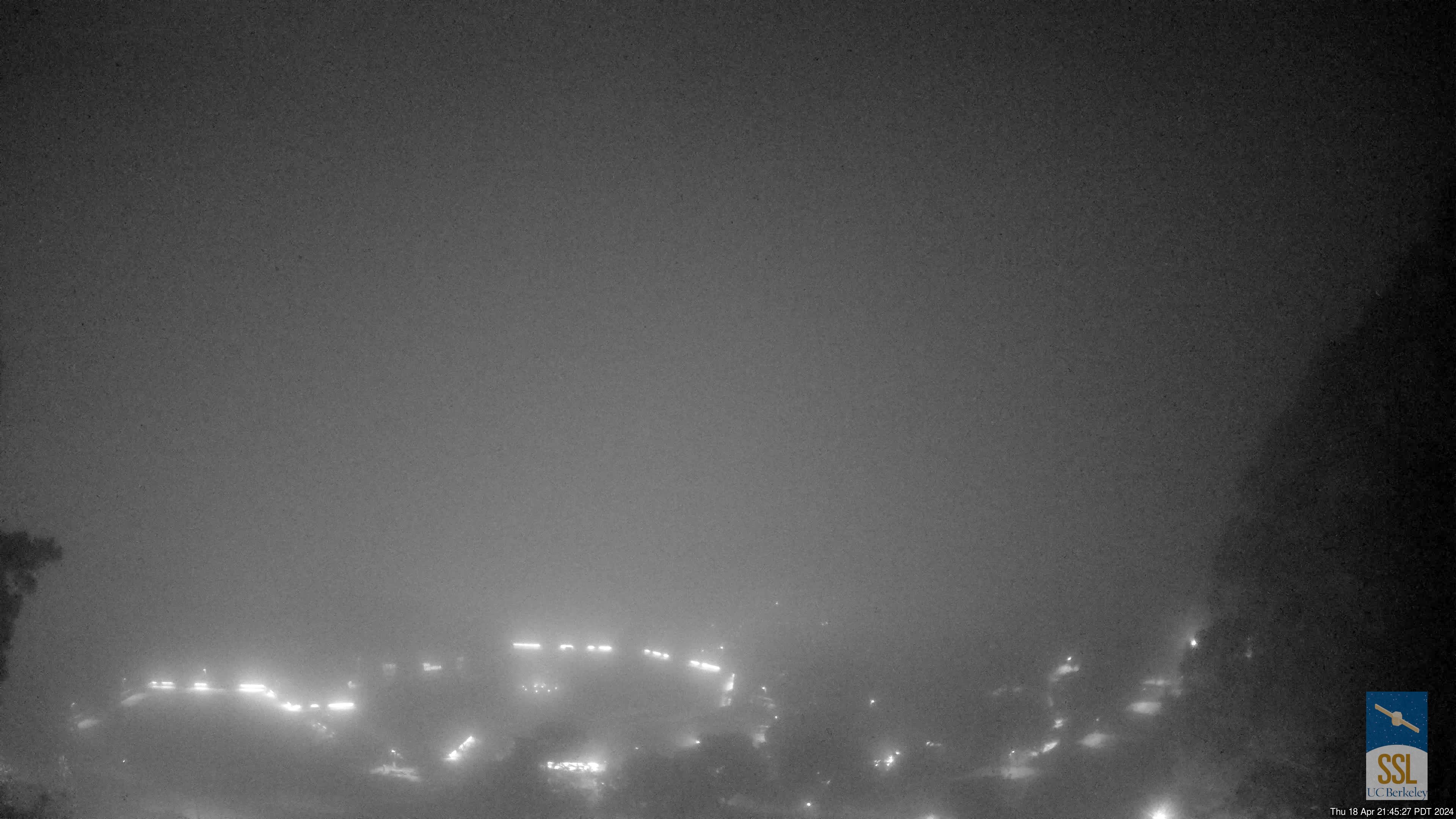
Live View

Clicking the image will load a larger JPEG (3840×2160). The image refreshes every minute.
LANDMARK VIEW
FORECAST AND AQI
View the US-EPA Fire and Smoke Map for Berkeley, CA
View a map with the data from our Purple Air air sensor.